
Wheeler Ownership Eras
The newest deed is the stable anchor. Everything before it branches. The GSCCCA central index reaches from 1990 forward. But Wheeler's own good-from dates and scanned images decide what is actually viewable. Older books remain a task for the Clerk and the archives. Wheeler County was cut from Montgomery County in 1912. A chain may cross a county line on paper, but the land itself never moves.
| Source | Years It Covers | Where Held | What It Shows |
|---|---|---|---|
| GSCCCA central index | Visible banner starts 1990 | Online | Party, instrument, date, book/page |
| Wheeler deed books | County era from 1912 | Superior Court Clerk | Conveyances and legal descriptions |
| Archives plats | 1939-1941 | Georgia Archives | District, property, acreage, owner and lots |
| Montgomery records | Pre-1912 leads | Montgomery custodian | Earlier chain for later Wheeler land |
A name by itself proves little. Book and page, the legal description, plat reference, acreage, and adjoining land clues keep the chain tied to one property.
The Wheeler 1990 Screen
The GSCCCA name search filters by party, instrument, county, neighboring county, name, and date. Those controls make it the fastest route to former owners. The 1990 banner is not proof. Images may not all begin there. Older records can still exist locally. Apply the county good-from control when it is offered.
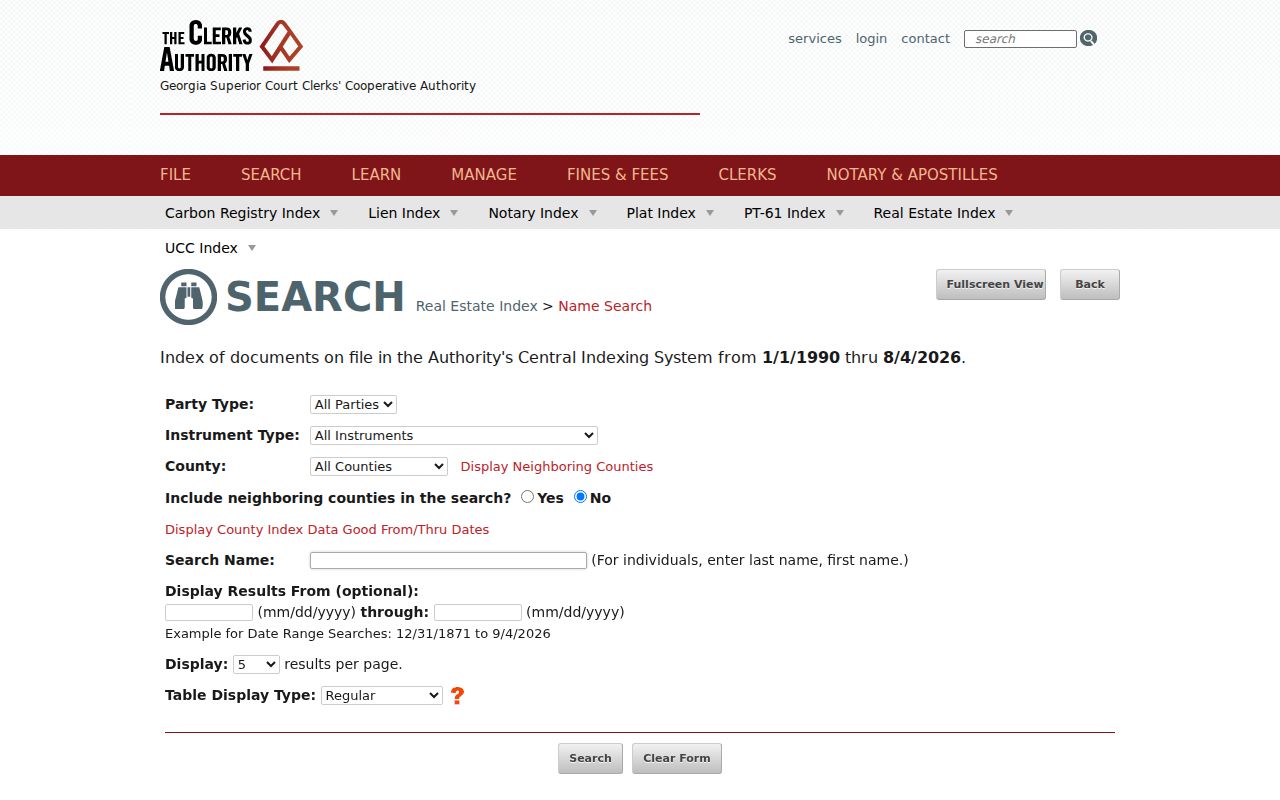
If a hit lacks an image, request a copy from the Wheeler Clerk using its book and page.
Reconstruct Wheeler Deeds Backward
The latest grantee is the current-deed lead. The grantor is the prior-owner lead. Search that grantor as an earlier grantee, then confirm the legal description still identifies the same tract.
- Find the current owner's acquisition deed with that owner as grantee.
- Read the grantor, date, prior reference, and legal description.
- Search the grantor as an earlier grantee and compare land calls.
- Repeat until the description changes or online coverage ends, then use deed books.
- Grantor
- The party conveying an interest.
- Grantee
- The party receiving it.
- Chain of title
- The ordered series of deeds for the same land.
- Legal description
- The lot, tract, district, acreage, bounds, or plat language.
Plats Unlock Wheeler Place Names
The GSCCCA plat index and the Clerk tie lot-and-block text to maps, and Georgia Archives holds two Wheeler plat volumes from 1939 through 1941, indexed by land district, section, property number, acreage, and owner.
Alamo offers clear examples. Hinson Heights sits at plat book 1, page 233. Old Still Block appears at plat book 3, page 108, from a 1969 survey. Glenwood research leans on railroad, downtown, school, and highway frontage clues. Check every place name against the deed.
Probate Adds Transfer Authority
A deceased owner's name can lead the search to Wheeler Probate Court. There, a will, letters, inventory, deed of assent, and final settlement show who held authority. Death alone does not transfer the parcel. Find the recorded conveyance that follows.
Call Probate Court at 912-568-7133 with the exact name and dates. The court publishes no online search portal or fee page. So confirm counter and mail procedures.
Reach Older Wheeler Records
The Wheeler Clerk at 16 West Pearl Street, Suite 101, in Alamo holds the local deeds and plats; call 912-568-7137 about books, images, certified copies, or corrections. Mail goes to P.O. Box 38. Confirm fees first. GSCCCA eCertification serves qualifying electronic orders.
Georgia Archives is the historic fallback. The Wheeler County Library at 61 West Main Street and the Wheeler County Eagle archive, whose title record runs from 1913 to the present, supply subdivision names and estate notices. Newspaper OCR can misread a surname or number, so compare the scan against the deed.
Wheeler Notices Bridge Records
Legal notices can preserve the exact terms that restart a broken deed chain. The 2026 tax-sale entries show how. They pack parcel keys, current record-holder names, tax years, acreage, land lot and district, deed book and page, plat book and page, and situs details into one notice. Copy the whole bundle. One field alone can mislead. Newspaper OCR damages names and numbers, so the combined fields identify the instrument.
Old Wheeler Address Clues
Old Wheeler County deeds rarely match today's street number. An Alamo chain may instead point to Railroad Avenue, the official city plat, a block letter, or names like Hinson Heights, A.C. McLennan Subdivision, and Old Still Block. Glenwood records lean on other anchors. There the railroad, the downtown commercial block, the old school, US 280, or Georgia 19 marks the land. Rural parcels are different again. A Wheeler County description may rest on a creek, a road, a land lot, a district, or an adjoining owner. Search the Wheeler County Eagle archive and plat index with those terms. Then weigh each deed against the parcel. Compare parcel geometry, acreage, and the owners on each side before trusting a match.
A landmark only supplies vocabulary. It proves nothing about ownership on its own. Keep old and new road names side by side, since an E-911 address change or a renamed street often explains the mismatch.
Test Each Wheeler Chain Link
Test every link the same way. Start with the grantee. The earlier deed should name the later grantor as its grantee. Next, check the legal description, because a person often held more than one Wheeler County parcel, and the tract described must be the tract you are tracing. Dates need to run in a sensible order. The later deed should also cite the earlier book and page, and any failed test must be explained before you keep moving backward through the deed records.
Track Wheeler Acreage Changes
Acreage rarely shifts without cause. A split, an assemblage, a boundary correction, or a right-of-way can change the size. A partial conveyance can change it too. All of these appear in Wheeler County property records. Instead of forcing two legal descriptions into one, lay the plat references side by side. Then study the adjoining owners. Between outright conveyances, the deed books also hold security deeds, assignments, cancellations, liens, and releases. Those instruments count toward the history of the parcel. None of them creates a former owner of record. So read the instrument type and each party's role before you draw conclusions about who held title.
Handle Wheeler Name Changes
People are not the only parties who change names. A Wheeler County property search has to cover initials, spelling variants, estate forms, and exact business names. One deed may record the same owner three different ways. GSCCCA can display neighboring counties too. That helps when a parcel sits near a county line. For older land, though, the deeper question is jurisdiction rather than spelling. Anything before 1912 belongs to Montgomery County, because Wheeler County had not yet been created. Note the reason for the change in your timeline. Keep the old county name attached to that stretch of the chain.
Build a Wheeler Owner Timeline
A good timeline is the backbone of any former-owner search in Wheeler County. Order every entry by recording date. Give the execution date its own column when it differs. Each row should show the grantee and the grantor. Add the instrument type, the book and page or document number, a legal-description checkpoint, and the source. Note a plat, an estate case, or a newspaper notice. Flag any correction or county transition too. Built this way, the table exposes a missing link fast. It also keeps a newspaper date from masquerading as a deed date.
Several local sources can anchor the middle of a long chain. The Archives plat series from 1939 through 1941 can pin down a lot or a land district. The Wheeler County Eagle can yield a subdivision name, a tax notice, or an estate clue. It may also give an adjoining owner or an older road term. In Alamo, the railroad and the official city plat may bridge an old block description to a modern street. Glenwood offers its own clues. They run from the railroad and highway corridor to the historic school and the downtown commercial blocks.
Keep doubt where it started. If OCR blurs a page number, flag that row for review against the original image. If two people share a name, demand the land description or another identifier before linking them. When the Clerk's book cannot be inspected yet, label the index hit as unconfirmed. A transparent gap in the record beats a smooth but invented list of former owners every time.
Where Wheeler History Changes Counties
A Wheeler County chain does not end when the online index does. Courthouse deed books and archives hold the earlier links. The chain usually crosses county lines at least once. Wheeler County was created in 1912. Any parcel traced past that year lands in Montgomery County, whose deed records carry the earlier owner of record. Keep that county name attached to each old deed. That way the Wheeler County property records stay honest. When a name matches but the deed does not, treat the link as a hypothesis. Mark the unresolved deed, land description, or county transition. Name the record that could settle it.
Lawful use. Former-owner records support house history and property diligence. Never use them to stalk, harass, threaten, or harm anyone.